
LIVING WITH LAKES SPEAKERS RECEIVE
RAVE REVIEWS!
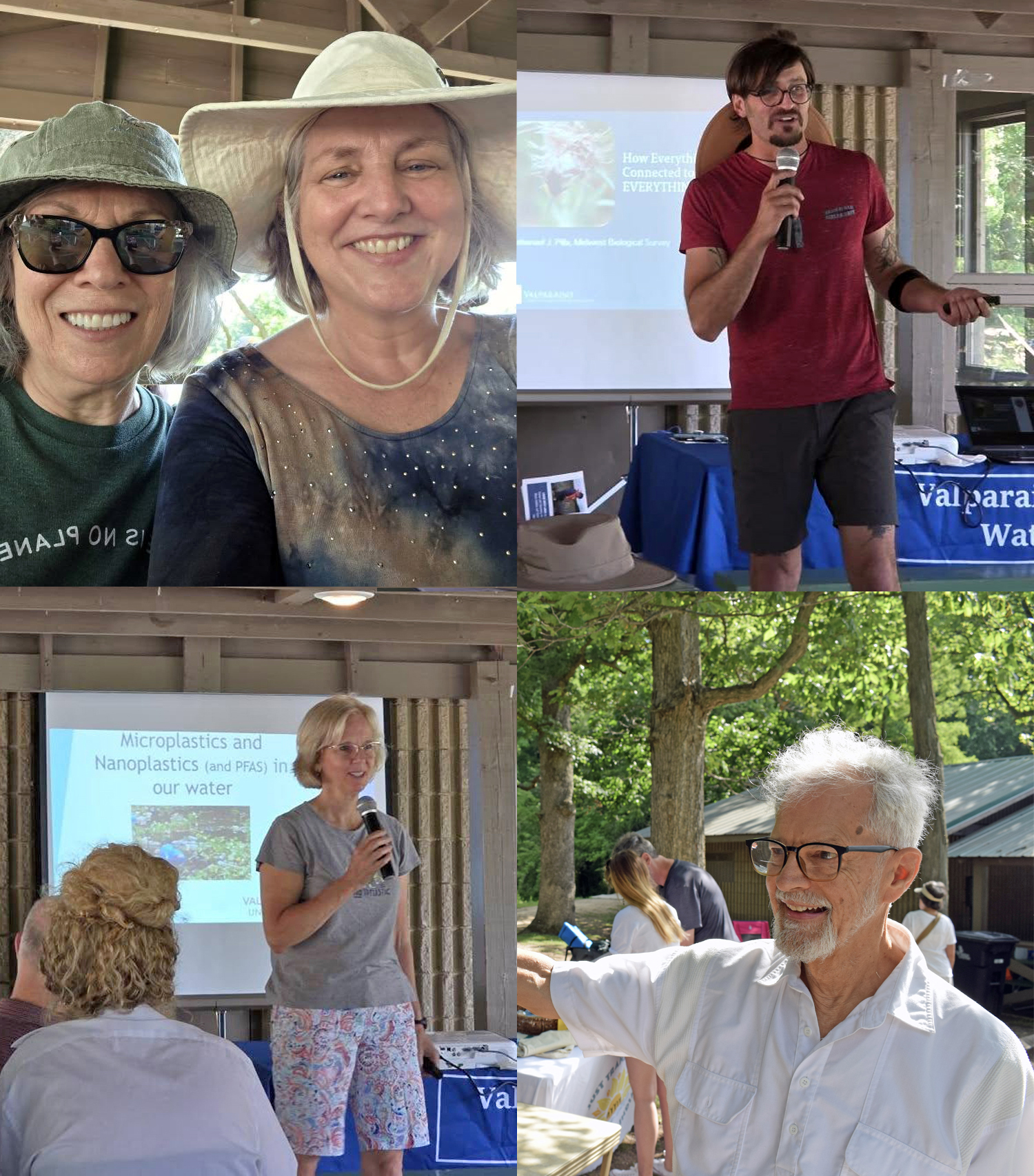
This year’s Living With Lakes Seminars was a big success bringing together local citizen scientists, environmentalists, conservationists, and community members who listened and learned from our panel of passionate experts, all with the goal of learning more about the Chain of Lakes and the surrounding watershed.

PUBLISHED: June 23, 2025 at 3:25 PM CDT
A small but dedicated audience braved the heat Saturday for the annual Living With Lakes Seminars at Rogers Lakewood Park in Valparaiso.
Various exhibitors, including Woodland Savanna Land Conservancy, Repower Indiana, and Shirley Heinz Land Trust staged information booths that attendees could peruse in between the four featured lectures.
Talks included Valparaiso University Associate Professor of Geography Jon-Paul McCool’s lecture on a geological perspective on the lakes, Midwest Biological Survery founder Nathanael Pilla’s lecture on how “Everything is Connected to Everything,” and Valparaiso University Chemistry Professor Julie Peller’s talk on micro and nonoplastics and their impact on the environment and public health.
Sam Carpenter, executive director of the Hoosier Environmental Council, was the final speaker of the day, focusing on protecting Indiana’s water. He started by asking the audience if they knew where Indiana’s water quality ranks. “We are number 50,” he confirmed to murmurs from the crowd of about 35 that remained from a height of 50 earlier in the day.
He gave Indiana Gov. Mike Braun credit for taking first steps in developing a comprehensive water plan for the state, but said, “What they aren’t really talking about is water quality.” Carpenter said so far, the state is just focused on industrial water use.
The Indiana Economic Development Corporation bought up 12,000 acres, “and then they realized, ‘We don’t have enough water to support this,’” Carpenter said of plans downstate. He said there had been talk of building a pipeline to bring up to 100 million gallons of water per day from the Wabash River to the LEAP district.
That prompted the audience to bring up data centers, referring to efforts by QTS to bring two large centers that would total nearly 800 acres to Wheeler. Carpenter said a data center can use the same amount of electricity as a medium-sized city. “We need to be very smart and cautious about this,” he said about accepting such a project, as efficient means of cooling the water used should be top priority.
You can read the entire story here>>